The Complete B2B GTM Agency Playbook: Strategy to Execution

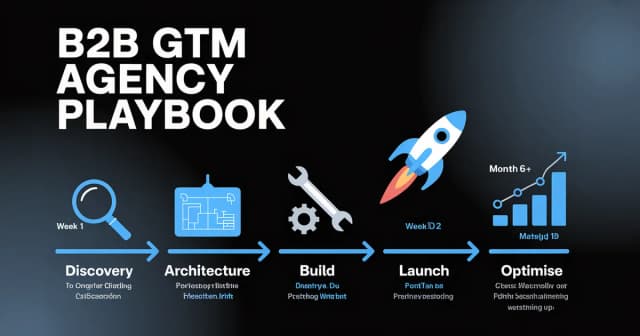
The Complete B2B GTM Agency Playbook: Strategy to Execution
Updated March 2026 — The exact process we run at UpliftGTM for B2B technology companies
This is the actual playbook we run at UpliftGTM. Not a framework diagram. Not a McKinsey-style methodology you hang on a wall. The real thing. Every phase, every deliverable, every decision point — laid out the way we actually execute it when a new client signs.
I'm sharing this because if you're evaluating GTM agencies, you deserve to know what the engagement looks like before you commit budget. And if you're a founder trying to build this internally, this will save you months of trial and error.
We've run this playbook for SaaS companies, cybersecurity firms, AI startups, fintech companies, and managed service providers. The details change. The phases don't.
Phase 1: Discovery & Diagnostic (Week 1-2)
On day one we're not building anything. We're diagnosing. This is where most companies — and honestly, most agencies — get it wrong. They jump straight into tactics. New email sequences. A content calendar. A shiny CRM dashboard. All built on top of assumptions that nobody has validated.
We spend the first two weeks pulling everything apart before we put anything together.
What we actually do
ICP Audit. Your Ideal Customer Profile is either wrong, incomplete, or exists only in someone's head. We interview your founders, sales team, and CS team. We pull CRM data — every closed-won deal from the last 12-24 months — and look for actual patterns. What industry? Company size? Who was the first contact? Who signed? How long was the cycle? What triggered the conversation? Salesforce's State of Sales research repeatedly finds that sellers waste enormous time on poor-fit accounts, and an honest ICP audit is the cheapest way to fix that.
Nine times out of ten, the ICP a company describes to us doesn't match the companies they've actually closed.
Tech Stack Review. We audit every tool in your revenue stack — CRM, sequencing tools, enrichment platforms, intent data, marketing automation, analytics. We're checking how it's configured, what's connected, and what's actually being used versus burning budget.
I can't tell you how many times we've found companies paying for six overlapping tools, none configured properly. The tech stack review alone usually saves clients enough to offset a significant chunk of the engagement cost.
Competitive Analysis. Not a SWOT matrix. We pull apart what your competitors are actually doing. What channels are they investing in? What does their outbound look like? (We sign up for their sequences, pull their email infrastructure, run their domains through Ahrefs.) Where are they showing up that you're not?
Pipeline Forensics. The one that makes people uncomfortable. Where are deals stalling? What's your real conversion rate at each stage — not the board deck number? How many "opportunities" are really proposals that went dark six months ago?
Phase 1 deliverables
By the end of week two, you get:
- ICP Document. Validated firmographic and technographic criteria, buying committee map with titles and responsibilities, trigger events, disqualification criteria. Typically 8-12 pages. This becomes the targeting foundation for everything else.
- Tech Stack Audit. Current state assessment with specific recommendations — what to keep, what to cut, what to add, what to reconfigure. Tool-by-tool with estimated costs.
- Competitive Intelligence Report. Channel-by-channel breakdown of competitor GTM activity with specific gaps and opportunities.
- Pipeline Health Assessment. Honest evaluation of current pipeline with stage-by-stage conversion analysis and revenue forecast reality check.
- 90-Day Roadmap. Prioritised plan covering phases 2-4 with specific milestones, owners, and success metrics.
This phase is non-negotiable. We've had prospects push back — "We already know our ICP, can we skip to building?" — and the answer is always no. The Clarizen engagement is a perfect example. We walked through this exact discovery process and uncovered that their targeting was focused on the wrong segment entirely. If we'd skipped straight to building outbound sequences, we'd have been sending beautifully crafted emails to the wrong people.
Phase 2: Architecture (Week 2-4)
Discovery told us where we are. Architecture defines where we're going and exactly how we'll get there. This is the engineering phase — we're designing systems, not just picking tactics.
GTM Strategy Document
This isn't a slide deck. It's a working document that covers:
- Market positioning. How you win against each competitor in each segment. What you say, what you don't say, how you're different in terms the buyer actually cares about.
- Channel architecture. Which channels we're going to invest in and why. This is a strategic decision, not a checklist. A SaaS company selling $50K ACV deals to VP Engineering has a completely different channel mix than a cybersecurity company selling $200K platform deals to CISOs. We're selecting channels based on where your specific buyers actually spend their time and attention.
- Sequencing and phasing. What launches first, what launches second, what we hold until we have data. You can't do everything at once. The architecture phase decides the order of operations.
Messaging Framework
We build messaging at three levels:
- Company level. Your core value proposition, positioning statement, and proof points. This is the foundation everything else builds on.
- Persona level. Different messages for different buyers. The CTO cares about different things than the CFO. The end user has different pain points than the decision maker. We build specific messaging for each person in the buying committee.
- Channel level. How the message adapts for cold email versus LinkedIn versus a sales call versus a landing page. Same core story, different execution.
We test messaging frameworks in Clay before we commit to them. Build a list of 200 accounts, run the messaging through personalisation at scale, and see how it reads for real companies before a single email goes out.
KPI Definition
Not "generate more pipeline." Actual numbers. How many qualified meetings per month at steady state? What reply rate do we need? What's the target cost per qualified meeting? What organic traffic milestones matter at 90, 180, and 360 days?
We tie these back to revenue targets and work backwards. If you need $2M in new ARR and your average deal is $80K, that's 25 closed deals. At a 20% close rate, that's 125 qualified opportunities. At a 15% meeting-to-opportunity rate, that's roughly 830 meetings. Now we know how hard the outbound engine needs to work.
Phase 2 deliverables
- GTM Strategy Document. 15-25 pages covering positioning, channel architecture, phasing, and resource requirements.
- Messaging Framework. Company, persona, and channel-level messaging with supporting proof points.
- KPI Dashboard Template. Pre-built in HubSpot (or your CRM) with the specific metrics we'll track.
- Channel Playbooks. Detailed operational plan for each active channel.
Phase 3: Build (Week 3-8)
This is where most of the work happens. Phase 3 is pure execution — building the infrastructure that will generate pipeline for the next 12-24 months. We typically have multiple workstreams running in parallel.
Outbound Infrastructure
The outbound system is usually the first thing we build because it produces results fastest.
Email domains and warmup. We set up 3-5 secondary sending domains, configure SPF, DKIM, and DMARC, and begin a 14-21 day warmup process using Instantly. Boring technical work that determines whether your emails land in inboxes or spam. Google's published sender requirements make authentication and reputation non-optional for any volume sender. Skip it and nothing else matters.
Enrichment and list building. Target account lists built in Apollo, enriched through Clay with technographic data, intent signals, and personalisation variables. Typically 2,000-5,000 accounts in the initial list, segmented by ICP tier and buying stage. We benchmark enrichment vendors against independent reviews such as Cleanlist's 2025 ranking of B2B data providers so the contact data underneath every sequence is actually accurate.
Sequence creation. We write 4-6 initial sequences, each with 5-7 steps across email and LinkedIn. Every sequence tied to a specific ICP segment and persona. A sequence targeting a VP of Sales at a Series B fintech reads completely differently from one targeting a CISO at a mid-market healthcare company.
CRM configuration. Lead routing, lifecycle stages, deal stages, automation workflows, reporting dashboards — all configured in HubSpot. The goal: when a reply comes in, your team knows exactly what to do with it without manual triage.
SEO Foundations
While outbound spins up, we're building the SEO engine in parallel — along with generative engine optimization to capture visibility in AI-powered search tools like ChatGPT and Perplexity. The AI-search side of this is moving fast: Google's product blog has documented the shift toward AI Overviews and generative results, and Search Engine Land tracks the practical SEO and GEO implications every week.
Technical audit and fixes. Comprehensive crawl through Ahrefs — broken links, missing meta descriptions, thin content, crawl errors, site speed. For companies on Webflow, this means CMS settings, image optimisation, collection structures, and URL architecture cleanup.
Content strategy and production. Based on Phase 2 keyword research, we build a content calendar — typically 12-16 pieces for the first 90 days. Pillar content, supporting articles, comparison pages, and bottom-of-funnel landing pages. All mapped to the buyer journey and internally linked for topical authority.
On-page optimisation. Every existing page reviewed and optimised. Title tags, meta descriptions, header structure, internal linking, schema markup. Most B2B tech sites are leaving easy traffic on the table through basic on-page issues.
Sales Enablement Build
The sales enablement workstream runs parallel to outbound and SEO.
- Battle cards. One per major competitor, built from actual competitive intelligence, structured for quick reference during calls.
- Sales deck. Not a 40-slide corporate overview. A 10-12 slide deck designed around the discovery conversation flow with modular sections that reps can customise by vertical.
- Objection handling playbook. The 15-20 most common objections with specific response frameworks. Built from interviews with your current reps about what they actually hear on calls.
- Discovery question framework. Structured qualification methodology tied to your specific deal stages and buying committee.
If you need dedicated prospecting capacity, this is also where we scope the SDR agency team. We assign SDRs, brief them on the ICP, walk them through the sequences and battle cards, and start the training process so they're ready to go live when the infrastructure is warmed up.
AI Integration
The AI GTM systems layer gets built on top of the infrastructure, not alongside it. We need the data flowing before we can automate intelligently.
- Lead scoring models. Using engagement data, intent signals, and firmographic fit to prioritise accounts automatically.
- Personalisation at scale. Clay workflows that pull in company news, tech stack data, hiring signals, and funding events to generate personalised email openers and value propositions for every prospect.
- Automated research. AI agents that monitor target accounts for trigger events — leadership changes, funding rounds, product launches, competitive displacements — and surface them to your SDRs in real time.
Phase 3 deliverables
- Fully warmed email infrastructure with 3-5 sending domains
- 2,000-5,000 enriched target accounts loaded in CRM
- 4-6 outbound sequences live and ready to send
- CRM fully configured with automation, routing, and reporting
- Technical SEO issues resolved
- 8-12 content pieces published or in production
- Sales enablement suite (battle cards, deck, objection playbook, discovery framework)
- AI enrichment and personalisation workflows operational
- SDR team briefed and trained (if applicable)
By week three you should see the infrastructure taking shape. By week six, outbound should be live and generating replies. By week eight, the full system should be operational.
Work with UpliftGTM
Want a team to build this for you?
UpliftGTM designs and runs outbound, SDR and SEO systems for B2B technology companies. Book a call and we'll map it to your pipeline.
Phase 4: Launch & Iterate (Week 6-12)
Going live is not the finish line. It's the starting line. Phase 4 is where we take everything we built and start generating real data — then use that data to optimise relentlessly.
The First Two Weeks Live
The first sends go out. Sequences are active. LinkedIn outreach is running. And here's the part that makes clients nervous: the first two weeks are mostly about learning, not winning.
Reply rates tell us whether messaging resonates. Open rates tell us about deliverability. Bounce rates tell us about data quality. We're watching daily, not weekly, because a deliverability issue on day three becomes a domain reputation problem by day ten.
First Meetings
By week two or three, meetings start appearing. The first five to ten meetings are the most important of the entire engagement — not for the revenue, but for what they teach us. We sit in on these calls and listen for: Does the prospect match our ICP in reality? Did the messaging match their actual pain? Were there objections we didn't anticipate? Was the SDR-to-AE handoff smooth?
This feedback loops directly into sequences, messaging, and ICP definition. Phase 1 gave us hypotheses. Phase 4 gives us data.
Weekly Optimisation Cadence
From week six onwards, we run a structured weekly cadence:
Monday: Data review. Pull the numbers from the previous week — sends, opens, replies, positive replies, meetings booked, meetings held, opportunities created. Compare against KPI targets from Phase 2.
Tuesday-Wednesday: Adjustments. Update sequences based on performance data. Swap out underperforming subject lines. Adjust targeting criteria. Test new messaging angles. Update content based on what questions prospects are asking.
Thursday: Pipeline review. Joint call with your sales team to review active opportunities, identify stalled deals, and agree on next steps. This is where sales enablement materials get pressure-tested and updated.
Friday: Report and plan. Weekly summary to leadership covering metrics, insights, actions taken, and priorities for the following week. No vanity metrics. Pipeline generated, meetings booked, revenue influenced.
What to Measure
The metrics that actually matter during Phase 4:
- Email deliverability rate. Should be above 95%. Below that and you have an infrastructure problem.
- Open rate. 45-65% for cold outbound is healthy. Below 40% means subject lines or deliverability need work.
- Positive reply rate. 3-8% for cold outbound to net-new accounts. This is the number that determines whether outbound math works for your business — and it tracks roughly with the connect and conversion rates that ZoomInfo's cold-calling and outbound benchmarks report across mid-market B2B teams.
- Meeting booking rate. Percentage of positive replies that convert to scheduled meetings. Should be above 50%.
- Show rate. Percentage of scheduled meetings that actually happen. Below 75% means your confirmation and reminder process needs fixing.
- SAL rate. Percentage of meetings your sales team accepts as qualified. This is the ICP accuracy metric. Below 60% means targeting needs adjustment.
- Content performance. Impressions, clicks, rankings for target keywords, organic traffic growth. SEO is a trailing indicator — expect meaningful movement starting around month three.
When to Pivot
Not everything works the first time. That's not failure — that's the process. But you need to know when you're iterating and when you're burning money on something that won't work.
We apply what I call the three-week rule. Give any new sequence, channel, or messaging approach three weeks of clean data before making a judgment. Less than that and you're reacting to noise. More than that and you're being stubborn.
If after three weeks a channel or approach isn't showing directional signals — not necessarily hitting targets, but trending in the right direction — we either fundamentally rethink the approach or reallocate the resources.
Phase 4 deliverables
- Weekly performance reports with specific metrics
- Optimised sequences (expect 2-3 full iterations during this phase)
- Updated ICP criteria based on meeting feedback
- Refined messaging framework based on live data
- Content performance tracking and SEO progress reports
- Pipeline attribution model showing which channels and sequences generate the best opportunities
Phase 5: Scale & Handoff (Month 3-6+)
If Phase 4 is about finding what works, Phase 5 is about making it repeatable and transferring ownership to your team. This is where the system ownership model we talk about actually materialises.
Team Training
We don't just hand over documentation and wish you luck. We train your team — person by person, function by function — on every system we've built.
For outbound, this means your SDR team can independently manage list building in Apollo, enrichment in Clay, sequence management in Instantly, and CRM workflows in HubSpot. Hands-on training, not slide presentations.
For SEO, we train your marketing team on keyword research, content workflows, technical monitoring, and performance tracking in Ahrefs and Google Search Console.
For sales enablement, we train sales leadership on maintaining and updating materials as the product, competitors, and objections evolve.
Documentation
Everything gets documented — in your systems, in your tools, in formats your team actually uses.
- Outbound Operations Manual. List building, enrichment, sequence creation, A/B testing, deliverability monitoring, reporting, and troubleshooting.
- SEO Playbook. Content workflow, keyword research process, technical checklist, internal linking guidelines, performance tracking cadence.
- Sales Enablement Maintenance Guide. Updating battle cards, refreshing decks, capturing new objections.
- CRM Administration Guide. Configuration, automations, reports, and how to modify them.
- AI Workflow Documentation. Every Clay workflow and automation, with instructions for modifying parameters as targeting evolves.
Process Handoff
The handoff happens gradually, not all at once. Typically over 4-6 weeks:
- Week 1-2: We run systems, your team shadows and asks questions.
- Week 3-4: Your team runs systems, we shadow and course-correct.
- Week 5-6: Your team runs independently, we review output and provide feedback.
By the end of this process, your team should be operating the full GTM system without daily input from us. That's the test. If they can't, we haven't done our job properly.
Hiring Support
Often by month three, clients need to expand their team. We help with GTM recruitment — writing job descriptions, sourcing candidates, structuring interview processes, and evaluating candidates against the specific systems we've built — and our roundup of the best GTM recruitment agencies compares specialist alternatives. Hiring an SDR manager who's going to run the outbound system we designed is very different from hiring a generic "sales manager." We know exactly what skills and experience the role needs because we built the thing they'll be operating.
Ongoing Optimisation
For clients who want continued support beyond handoff, we offer ongoing optimisation engagements — typically lighter-touch, focused on strategic oversight, quarterly reviews, and advanced projects like expanding into new markets or verticals. Many of our clients in healthtech and HR tech started with a full build engagement and now operate on a quarterly strategic review model.
The work we did with Versa Networks followed this exact trajectory. Full build, handoff, then ongoing strategic partnership as they scaled into new market segments.
Phase 5 deliverables
- Trained internal team capable of running all GTM systems independently
- Complete operational documentation for every system and process
- Recruitment support for GTM roles as needed
- Transition to ongoing optimisation or strategic advisory (optional)
- Final engagement report with performance summary, lessons learned, and forward-looking recommendations
Where It Usually Goes Wrong
Every phase has failure points. I'd rather tell you about them upfront than have you discover them in the middle of an engagement.
Phase 1 Failures
Skipping discovery. The most common and most expensive mistake. "We already know our ICP" is the sentence that precedes six months of wasted outbound spend more often than any other. Even if you're right, validating takes two weeks. If you're wrong, it saves you six months.
Leadership not participating. Discovery only works if we can talk to the people who actually know the business. If the founders are too busy to sit for ICP interviews, or the sales team treats it as a distraction, the diagnostic is built on incomplete information.
Phase 2 Failures
Trying to do everything at once. The architecture phase should produce focus, not a laundry list. If the GTM strategy document has twelve active channels launching simultaneously, nobody's doing any of them well. We push back hard on this. Pick three channels. Prove them out. Then expand.
Vanity KPIs. If your KPI definition includes metrics like "brand awareness" or "social media followers" as primary success measures, the architecture is pointed in the wrong direction. Those things can matter. They're not what a GTM engagement measures first.
Phase 3 Failures
Cutting corners on deliverability. The email warmup process takes 2-3 weeks. There's no shortcut. Clients who push to send volume before domains are warm end up with deliverability problems that take months to recover from. I've seen companies burn through five domains in three months because they wouldn't wait for proper warmup.
Generic messaging. If your cold email reads like it could have been sent by any company to any prospect, it will perform like it. Personalisation isn't optional. The difference between a 1% reply rate and a 5% reply rate usually comes down to how specific the messaging is to the recipient's actual situation.
CRM neglect. Building sequences without configuring the CRM properly means replies come in and nobody knows what to do with them. Leads get lost. Follow-ups get missed. You're generating interest that your process can't capture.
Phase 4 Failures
Reacting too fast. Changing sequences after three days because the reply rate is low. You don't have enough data yet. Let it run. Three weeks, minimum.
Reacting too slow. The opposite problem. Running the same underperforming sequence for six weeks because "it'll improve." If the data says it's not working after three weeks of clean volume, change it.
Ignoring call quality. Meetings booked is a vanity metric if the meetings are terrible. We've seen teams celebrate booking 40 meetings in a month, only to find that 30 of them were with the wrong persona or wrong company size. Measure what matters: qualified opportunities created, not meetings held.
Phase 5 Failures
Rushing the handoff. The transition from agency-operated to internally-operated needs to be gradual. Flipping the switch overnight usually means quality drops, processes break, and you end up calling us back three months later to fix what your team couldn't maintain.
Not hiring. The systems we build need people to run them. If you don't hire (or reallocate) team members to operate the GTM engine, it decays. Sequences go stale. Content production stops. The CRM drifts out of calibration. Systems don't run themselves.
Timeline Expectations
I'm going to be realistic here, not optimistic.
Outbound pipeline. First qualified meetings in weeks 4-6. Steady-state meeting volume by month 3. This assumes clean discovery, proper infrastructure build, and no major pivots needed. If the ICP needs significant adjustment after launch (which happens about 30% of the time), add 3-4 weeks.
SEO pipeline. First signs of organic traffic improvement by month 2-3. Meaningful lead volume from organic by month 4-6. Compounding returns from month 6 onwards. SEO is the slowest channel to start and the highest-ROI channel over time. Companies we work with across networking and software verticals typically see SEO become their top pipeline source by month 8-12.
Sales enablement impact. Almost immediate once materials are deployed. You'll see it in shorter sales cycles, higher win rates, and faster rep ramp time. Typically measurable within the first month of use.
Full system maturity. A complete GTM system — outbound, SEO, enablement, AI, and recruitment working together — reaches maturity around month 6. That's when the flywheel effect kicks in. Outbound generates meetings, content supports the sales conversation, enablement improves close rates, AI makes everything more efficient, and the right people are in the right roles.
Anyone who tells you they can build a mature GTM system in 30 days is either lying or defining "GTM system" very differently than I do. Ninety days gets you operational. Six months gets you mature. Twelve months gets you compounding.
What This Costs
I'll be direct because vague pricing helps nobody.
A full-stack GTM build — all five phases, outbound plus SEO plus enablement plus AI — typically runs between $15,000 and $30,000 per month depending on scope, market complexity, and whether you need us to run SDR as a Service or B2B lead generation on an ongoing basis.
Smaller engagements focused on a single channel — just outbound, or just SEO — start lower, typically $5,000-$10,000 per month.
We cover this in detail in our GTM agency cost and pricing guide, which breaks down what drives cost, what to expect at different investment levels, and how to evaluate whether the ROI makes sense for your specific situation.
The way I think about it: if your average deal size is $50K+ and your sales cycle is 3-6 months, a GTM agency engagement that generates even 5-10 additional qualified opportunities per month pays for itself multiple times over. Use our SDR ROI calculator to model the specific economics for your business.
The investment goes down over time, too. The heaviest spend is in the build phase (months 1-3). Once systems are operational and your team is trained, ongoing optimisation engagements run at a fraction of the initial investment.
This Is How We Work
That's the playbook. Five phases, roughly six months from kickoff to system maturity, with pipeline generation starting in the first 60 days.
It's not magic. It's a disciplined process refined across dozens of engagements with B2B technology companies ranging from pre-revenue startups to $50M+ ARR.
The reason it works: the pieces connect. Outbound is built on a validated ICP. Content supports the sales conversation. Enablement turns meetings into pipeline. AI makes everything more efficient. Recruitment ensures the right people run the machine. Analyst research from Forrester consistently shows that the highest-performing revenue organisations are the ones that align marketing, sales, and CS around a single operating system rather than running each function as a silo — which is exactly what this playbook is designed to produce.
If you're evaluating whether to work with a Go To Market agency, the question isn't whether this playbook is right. It's whether the agency you're talking to has a playbook at all — and whether they'll show it to you before you sign.
We just did.
If this looks like what your company needs, let's talk. We'll walk you through how it applies to your market, your stage, and your targets.
Founder & CEO of UpliftGTM. Building go-to-market systems for B2B technology companies — outbound, SEO, content, sales enablement, and recruitment.
![How Much Does a GTM Agency Cost? B2B Pricing Guide [2026]](/_next/image?url=%2Fimages%2Fblog%2Fgtm-agency-cost-hero.webp&w=640&q=75)

![What Does a GTM Agency Do? The Complete Guide [2026]](/_next/image?url=%2Fimages%2Fblog%2Fwhat-does-a-gtm-agency-do-hero.webp&w=640&q=75)