How to Choose a GTM Agency for Your B2B Tech Company

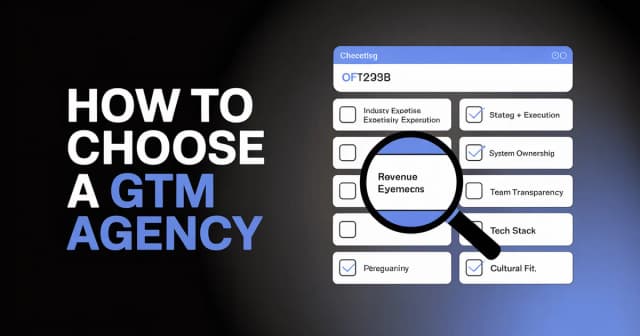
How to Choose a GTM Agency for Your B2B Tech Company
Updated March 2026 — A practical framework for evaluating go-to-market agencies
I'll tell you something uncomfortable: most companies choose their GTM agency wrong. They pick the one with the best pitch deck. The one whose founder showed up on a podcast they listen to. The one that promised a pipeline number in the first call without asking a single question about their ICP, sales cycle, or average deal size.
I've been on both sides of this conversation. I've sat across from agencies making promises they had no infrastructure to deliver. Now I run UpliftGTM, a Go To Market agency, specialist GEO agency listed in our roundup of the top GEO agencies for 2026, and AEO services partner — also covered in our best AEO agencies ranking — that works with B2B tech companies from Series A through to public. The gap between a good agency choice and a bad one almost always comes down to how the selection was made.
This is the framework I'd use if I were hiring a GTM agency tomorrow.
1. Industry Expertise That Goes Beyond Buzzwords
The first thing I evaluate is whether a GTM agency actually understands my market. Not whether they can recite industry statistics — whether they understand how deals get done. Salesforce's State of Sales research consistently shows that buyer expectations shift fast across segments, and an agency without sharp vertical context will misread those signals.
Selling cybersecurity to CISOs at enterprises is a completely different motion from selling workforce management software to operations directors at mid-market companies. The buying committees are different. The objections are different. The compliance requirements, the procurement process, the competitive landscape — all different.
When I was evaluating agencies before starting UpliftGTM, I talked to firms that claimed B2B tech expertise but couldn't tell me the difference between selling to a CISO versus a CTO. They couldn't explain why SaaS companies at $3M ARR face different GTM challenges than those at $15M. They had no concept of why networking infrastructure companies have sales cycles that look nothing like typical SaaS.
Here's what real industry expertise looks like: the agency can name your competitors before you tell them. They know which conferences your buyers attend. They can look at your current outbound sequences and tell you within five minutes why your reply rates are low. They've built pipeline in your vertical before and can show you the mechanics — not just a logo on a slide.
Ask them which verticals they've worked in. Ask for specifics. If they say "we work across all B2B" — that's not expertise, that's generalism dressed up as flexibility.
2. Strategy-Execution Integration
This is where most agency relationships break down, and it usually happens within the first 90 days.
You'll find two types of GTM agencies in the market. The first type does strategy. They'll spend six weeks building you a beautiful go-to-market plan — ICP analysis, competitive positioning, channel strategy, the works. Then they hand you a PDF and wish you luck. The second type does execution. They'll run your outbound, build your sequences, send the emails. But they never question whether the strategy underneath is sound. They just execute whatever brief they're handed.
Neither model works. What you need is an agency that does both and treats them as inseparable.
At UpliftGTM, our outbound system setup doesn't start with "give us your ICP and we'll start sending." It starts with pressure-testing the ICP itself. Are you targeting the right companies? The right personas? Are your trigger events actually correlated with buying intent or are they just firmographic filters someone picked out of thin air? Forrester's research on B2B buying has long shown that buying committees in tech routinely run to 6-10 stakeholders, which makes ICP precision the foundation of every downstream activity. We've had clients come to us with an ICP that was flatly wrong — they were targeting companies two sizes too large for their product — and if we'd just executed against that targeting, we'd have burned three months and a lot of money.
Strategy without execution is shelf-ware. Execution without strategy is expensive noise. The agency you choose should refuse to separate the two.
3. System Ownership Model — THE Key Differentiator
If you take one thing from this entire article, let it be this.
The single most important question you can ask any GTM agency is: what do I keep when this engagement ends?
I wrote about this in detail in our piece on what a GTM agency actually does, but it bears repeating because it's the dividing line between agencies that build value and agencies that extract it.
Some agencies run everything through their infrastructure — their CRM, their sequencing tools, their domains. You're renting access to their capability. The moment the contract ends, the pipeline stops because you never owned the engine.
That's not a partnership. That's a subscription with a cancellation penalty.
The right model means everything gets built inside your stack. Your HubSpot instance. Your Apollo or Clay setup. Your domains. Your content ranking under your brand. When we built outbound systems for Clarizen, the infrastructure lived inside their environment from week one. Same with Versa Networks. Same with TotalMobile. The system stayed. The knowledge transferred. The pipeline kept flowing.
Ask this question and watch their face. If they hesitate, if they start talking about "proprietary methodologies" or "our platform" — you're looking at a dependency model. Walk away.
4. Revenue Accountability
I have no patience for agencies that report on vanity metrics. None. And you shouldn't either.
If a GTM agency wants to talk about impressions, email open rates, or social media engagement in their reporting, they're telling you something important: they don't have confidence in their ability to move the numbers that actually matter. HubSpot's sales benchmarking work reinforces the same point — pipeline-quality and cycle-time metrics correlate with revenue outcomes; vanity activity does not.
A B2B GTM agency should measure and report on:
- Qualified meetings booked — not just any meeting, but meetings with the right people at the right companies
- Pipeline generated — actual opportunities created in your CRM with dollar values attached
- Pipeline velocity — how fast deals move from first touch to close
- Revenue influenced — which agency-driven activities contributed to closed-won revenue
- Cost per qualified meeting — what you're actually paying for each real opportunity
That's it. Everything else is a leading indicator or a distraction.
When we run B2B lead generation campaigns, clients can log into their CRM and see exactly which meetings, which opportunities, and which revenue came from our work. There's no black box. There's no "trust us, the brand awareness is building." You either produced pipeline or you didn't.
Ask any GTM agency you're evaluating to show you a real client report. Not a sanitised case study — an actual monthly report. If they can't, or won't, that tells you everything about how they think about accountability.
5. Team Structure and Transparency
Who is actually going to do the work?
You sit in a pitch meeting with two articulate senior partners who clearly know their stuff. You sign the contract. Then you never see those people again. Instead, you get a junior account manager juggling eight clients who's been at the agency for four months.
This bait-and-switch plagues the agency world. Before you sign, ask:
- Who will be my day-to-day point of contact?
- What's their background and how long have they been at the agency?
- How many other clients are they managing simultaneously?
- Will the senior people involved in the pitch remain involved in delivery?
- What does the team structure look like — and is it dedicated or shared?
At UpliftGTM, our SDR agency model uses dedicated SDRs — not shared resources bouncing between accounts. Our sales enablement work involves senior strategists who stay on the account, not juniors working from templates. The numbers back this up: ZoomInfo's analysis of cold-call performance shows connect rates and conversion improve materially when reps have continuity on an account rather than rotating across books. We're transparent about this because we think it's a competitive advantage, and because every client who's been burned by the bait-and-switch model asks about it immediately.
If an agency won't give you straight answers about team structure, they're hiding something you won't like.
6. Tech Stack Maturity
The tools a GTM agency uses — and how they use them — tell you a lot about their sophistication.
In 2026, a competent agency should operate across HubSpot or Salesforce for CRM, Apollo or ZoomInfo for prospecting data, Clay for enrichment and workflow automation, and AI tools for content, personalisation, and analytics. They should understand deliverability infrastructure — domain warming, DMARC, SPF, DKIM — because without it, your outbound never reaches an inbox. Google's bulk sender requirements tightened in 2024 and 2025, and the agencies that hadn't already operationalised authentication and complaint thresholds saw their inbox placement collapse.
But tool sophistication alone means nothing. I've seen agencies with enterprise-grade stacks who couldn't book a meeting to save their lives. The question isn't what tools they use — it's whether they've built integrated systems that make those tools work together.
Our AI GTM systems work is about building workflows where AI amplifies what's already working — intent signal processing feeding Clay enrichment workflows, triggering personalised sequences in Apollo, syncing back to HubSpot with full attribution. Each piece talks to the next. The system compounds.
Ask your prospective agency to walk through their stack architecture. Not a logo slide — an actual workflow diagram showing how data moves from identification to pipeline. If they can't draw it on a whiteboard, they haven't built it.
7. Cultural Fit
This sounds soft. It's not. Cultural fit determines whether the relationship survives the inevitable rough patches — the campaign that underperforms, the quarter where pipeline dips before it accelerates. According to the LinkedIn B2B sales blog, the highest-trust seller-buyer relationships are also the most resilient under pressure, and the same dynamic plays out between agency and client.
What to evaluate:
- Communication style. Do they communicate directly or hide behind jargon? When something isn't working, do they flag it immediately or bury it in a 40-page report?
- Speed. B2B tech moves fast. If your agency needs three weeks to turn around a new sequence, that's a mismatch.
- Intellectual honesty. Will they push back on bad ideas — including yours? If they just nod and execute whatever you ask, you're paying for order-takers, not strategic partners.
- Values alignment. Do they care about building something that lasts, or are they optimising for their next case study?
When we work with SaaS companies scaling fast, cultural fit means we match their urgency without cutting corners. When we work with established cybersecurity or networking companies, it means respecting their processes while challenging what isn't working.
Have a conversation — not a pitch meeting — before you sign. Coffee, a candid phone call. See how they behave when they're not performing.
Work with UpliftGTM
Want a team to build this for you?
UpliftGTM designs and runs outbound, SDR and SEO systems for B2B technology companies. Book a call and we'll map it to your pipeline.
Red Flags: What to Watch For
During the Sales Process
Red flag number one: Whether you're evaluating a GTM firm or a demand generation agency, they promise specific pipeline numbers before understanding your business. "We'll generate 50 qualified meetings per month" in the first conversation — without asking about deal size, sales cycle, or competitive landscape — means they're selling, not advising.
They can't show measurable outcomes. Logos aren't proof. What pipeline did they generate? What systems did they build? What happened after the engagement ended?
The senior people disappear after the pitch. If the people selling aren't the people delivering, ask why.
In the Proposal
Vague scope with aggressive pricing. Phrases like "strategic guidance," "ongoing optimisation," or "thought leadership development" without deliverables, timelines, and success metrics — you're buying fog.
No mention of system handover. If the proposal doesn't state what you own at the end, assume you own nothing.
Unrealistic timelines. Pipeline in two weeks? They either have a very different definition of "qualified" or they're lying.
In the Contract
Long lock-ins with no performance clauses. A 12-month contract with no opt-out if targets aren't met. Good agencies don't need to trap clients.
IP ownership ambiguity. Who owns the content, sequences, and data? Get it in writing.
Auto-renewal without notice periods. Read the fine print.
During Delivery
Reporting that avoids pipeline metrics. Monthly reports focused on activity (emails sent, calls made) rather than outcomes (meetings booked, pipeline created) means they're papering over poor results.
No access to your own data. If you can't log into the tools and see what's happening real-time, ask why.
Constant scope pivots without results. "We need to pivot the strategy" is sometimes legitimate. Every month? The agency is flailing.
12 Questions to Ask Before Signing
Use this as a literal checklist. Bring it to the meeting.
What do we own if this engagement ends tomorrow? The most important question. Non-negotiable.
Can you walk me through a specific client engagement — from kickoff to results — in our industry? Not a sanitised case study. The actual timeline, the challenges, the adjustments.
Who specifically will work on our account and what's their experience? Names, backgrounds, and client load.
How do you define a qualified meeting? If their definition doesn't match your sales team's, the numbers will look great and mean nothing.
What does your reporting look like and how often do we get it? Ask to see a sample. If they don't have one, that's your answer.
What's your approach to outbound deliverability? If they look confused, they don't understand modern outbound. Domain warming, inbox placement monitoring, sender rotation — this stuff matters enormously.
How do you integrate with our existing sales team? The answer should involve regular syncs, shared CRM access, and a feedback loop. Not "we'll send you a spreadsheet."
What happens when something isn't working? You want specificity here. How quickly do they iterate? What's the escalation process?
Can you show me your tech stack and how data flows between systems? See the section on tech stack maturity above. This separates operators from pretenders.
What's your stance on AI in GTM — and what have you actually built? Everyone talks about AI. You want to know what they've deployed, not what they're planning.
How do you handle competitive intelligence and positioning? Particularly relevant if you're in a crowded space. Do they build sales enablement materials that actually address competitive objections?
What would make you tell us we're not a good fit? An honest agency has criteria for who they work with. If the answer is "we work with everyone," they don't have standards.
Pricing Models Explained
GTM agency pricing is all over the map, and the lack of transparency in the industry makes it worse. Here's what you'll encounter.
Retainer Model
Fixed monthly fee for agreed scope. Most common, works well when scope is clear. Expect $8,000-$30,000/month depending on services. The advantage is predictability. The risk is scope creep turning your retainer into a fraction of what's actually needed.
Project-Based
Fixed fee for a defined deliverable — an outbound system build, or a comprehensive SEO overhaul delivered by one of the best SaaS SEO agencies. Works well for discrete initiatives. A full outbound system build typically runs $15,000-$40,000.
Fractional Model
A fractional GTM leader — part-time VP of GTM or Head of Growth embedded in your team. Suits companies needing senior strategic guidance alongside execution. We offer this through our GTM recruitment and advisory services. Expect $5,000-$15,000/month.
Performance / Hybrid Model
Lower base retainer plus performance bonuses tied to pipeline targets. Sounds attractive, but beware: performance models can create misaligned incentives. The agency optimises for meeting volume over meeting quality, or pushes deals that aren't truly qualified to hit bonus thresholds. If you go this route, make sure metrics align with revenue goals, not activity.
Progressive Engagement
Start small, test fit, then expand. This is what I'd recommend for any company new to GTM agencies. Run a 60-90 day pilot focused on one channel and evaluate based on real results before expanding scope.
What Good GTM Agencies Actually Deliver
Three things separate genuinely good GTM agencies from expensive distractions.
Systems, Not Services
A good agency builds infrastructure — repeatable, documented systems your team can understand, operate, and improve. Not black-box services that only work while you're paying the invoice. When we finish an outbound sales system setup, the client has documented playbooks, configured tools, trained people, and proven processes.
Pipeline, Not Activity
Activity is easy to manufacture. Send 10,000 emails, make 2,000 calls, publish 15 blog posts — look how busy we are. But activity without pipeline is overhead. A good GTM agency is obsessed with the conversion path: identified target to engaged prospect to qualified meeting to closed deal. Everything connects to that path or it gets cut.
Our work across fintech and healthtech has reinforced this. The companies that grow fastest aren't doing the most — they're doing the right things in the right sequence.
Enablement, Not Dependency
The ultimate test: are you more capable after working with the agency than before? Can your team run the outbound machine, maintain SEO momentum, enable new hires, leverage the AI systems — without the agency holding the on switch?
The best engagement ends with the client saying "we can take it from here" — and meaning it. That's not a failed retention outcome. That's success.
What You Need at Each Company Stage
Not every company needs the same GTM agency engagement. Here's what I've seen work at different stages.
Pre-$1M ARR
You probably don't need a full GTM agency yet. Keep it narrow — a 60-day sprint to build and test outbound, or a focused B2B go-to-market strategy engagement to validate ICP and messaging. Don't sign a $20K/month retainer at this stage.
$1M-$5M ARR
The sweet spot. You've got product-market fit and revenue traction — now you need to systematise what's been working on instinct. Focus on: outbound system build, sales enablement for your growing team, and the beginnings of an SEO engine. The right agency compresses 12 months of infrastructure-building into 90 days.
$5M-$20M ARR
You've got a team and processes, but things are cracking. The outbound that worked at $3M isn't scaling. Content is inconsistent. Enablement materials are stale. A GTM agency here serves as accelerator and gap-filler — standing up AI GTM systems, overhauling outbound, building the content flywheel, and helping you recruit GTM leaders who'll own it all in-house.
$20M+ ARR
Most GTM functions should be in-house. The agency's role shifts to specialist projects — entering a new vertical, standing up a new channel, fractional expertise for specific initiatives. Maybe you're expanding into the MSP market and need someone who's built pipeline there. Or you need an AI GTM overhaul. Surgical, not foundational.
Frequently Asked Questions
How long does it take to see results from a GTM agency?
Depends on the channel. Outbound can produce qualified meetings within 4-6 weeks once infrastructure is set up and warmed. SEO is a 3-6 month play for meaningful organic pipeline. Sales enablement delivers impact almost immediately — better discovery calls, stronger competitive positioning, faster onboarding. We set 90-day milestones with every client so expectations are calibrated from day one.
What's the difference between a GTM agency and a marketing agency?
A marketing agency handles brand, creative, and campaign execution — typically awareness and top-of-funnel. A GTM agency builds the full system from first touch to qualified pipeline, including outbound, sales enablement, tech stack, recruitment (often in partnership with the best GTM recruitment agencies), and AI. I've written a detailed comparison in our GTM strategy vs marketing strategy breakdown.
Can we start with one service and expand later?
Yes, and I'd actually recommend it. Start with your biggest bottleneck — outbound pipeline, content infrastructure, sales enablement — and run a focused engagement for 60-90 days. Evaluate results, then expand. This reduces risk and gives both sides a chance to prove fit before a larger commitment.
How do I know if my company is ready for a GTM agency?
You need three things: product-market fit (people are buying what you sell), a minimum viable sales process (even if it's founder-led), and willingness to act on what the agency finds. If your product hasn't been validated by paying customers, you're not ready. If leadership won't adjust strategy based on data, the engagement will stall.
Should I hire a VP of Sales first or engage a GTM agency first?
Agency first, almost always. A good VP of Sales needs systems to operate within. Hire them into a company with no outbound infrastructure, no content engine, no enablement materials — they'll spend six months building it all. That's expensive and slow. Bring in a GTM agency to build the foundation, then hire the VP to run it. We help with that transition through our GTM recruitment service.
The Bottom Line
Choosing a GTM agency is one of the highest-leverage decisions a B2B tech company makes. Get it right and you compress years of GTM infrastructure-building into months. Get it wrong and you've spent six figures learning what not to do.
Use the framework in this article. Ask the 12 questions. Watch for the red flags. Evaluate system ownership above everything else — because an agency that builds systems you own is investing in your capability, not their recurring revenue.
I'll be direct: I obviously think UpliftGTM is an excellent choice for B2B tech companies. We built the business around the system ownership model, we operate across every GTM function, and we've got the case studies to back it up. But I'd rather you choose the right agency using rigorous criteria than choose us because we wrote a convincing blog post.
If you want to talk through your specific situation — no pitch, just a straight conversation about what you need and whether we're the right fit — get in touch. I'll tell you honestly where we can help and where we can't.
Founder & CEO of UpliftGTM. Building go-to-market systems for B2B technology companies — outbound, SEO, content, sales enablement, and recruitment.
![How Much Does a GTM Agency Cost? B2B Pricing Guide [2026]](/_next/image?url=%2Fimages%2Fblog%2Fgtm-agency-cost-hero.webp&w=640&q=75)

![What Does a GTM Agency Do? The Complete Guide [2026]](/_next/image?url=%2Fimages%2Fblog%2Fwhat-does-a-gtm-agency-do-hero.webp&w=640&q=75)