What Does a GTM Agency Do? The Complete Guide [2026]

![What Does a GTM Agency Do? The Complete Guide [2026]](/_next/image?url=%2Fimages%2Fblog%2Fwhat-does-a-gtm-agency-do-hero.webp&w=640&q=75)
What Does a GTM Agency Do?
Updated March 2026 — What GTM agencies actually deliver for B2B technology companies
I get asked this question constantly. Founders, VPs of Sales, CROs — they've heard the term "GTM agency" thrown around, maybe seen it on LinkedIn, and they want a straight answer. What does a Go To Market agency actually do?
The short version: a GTM agency builds the go-to-market systems that generate qualified pipeline for B2B technology companies. Not brand awareness. Not "thought leadership" for the sake of it. Pipeline. Revenue. Meetings with the right people at the right companies.
But that's the elevator pitch. The real answer is more nuanced, and if you're evaluating whether to work with a go to market agency, the nuance matters.
I'm Jamie Partridge. I run UpliftGTM, and we've built GTM systems for companies ranging from Series A SaaS startups to publicly traded cybersecurity firms. What I'm going to lay out here is exactly what a GTM agency does — based on what we actually deliver, not what sounds good on a capabilities deck.
What a GTM Agency Is NOT
Before we get into what a GTM agency does, let me clear up three common misconceptions. This matters because if you hire the wrong type of partner expecting GTM outcomes, you'll waste six months and a lot of budget.
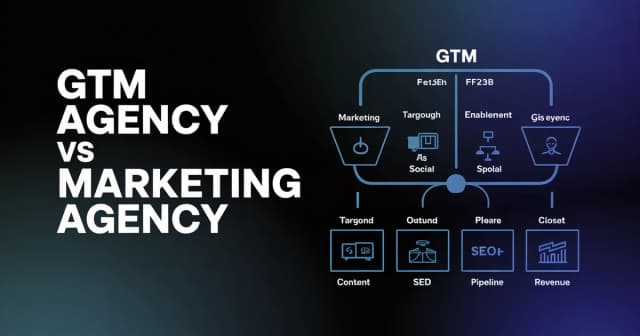
A GTM agency is not a marketing agency. Marketing agencies build campaigns. They'll run your paid ads, design your website, maybe handle your social media calendar. Some are excellent at it. But they don't touch your sales process, your outbound sequences, your ICP definition, or your hiring pipeline. A marketing agency handles one slice of the go-to-market motion. A GTM agency handles the whole system — including the sales-side execution that HubSpot's sales research consistently shows is where most B2B revenue actually gets won or lost.
A GTM agency is not a consulting firm. Consultants deliver decks. Strategy documents. Market analyses. Workshop facilitations. All useful, sometimes. But a consulting engagement typically ends with a PDF and a handshake. Nobody builds anything. Nobody runs anything. You're left with a strategy and no execution muscle. We've inherited more than a few clients who came to us holding a beautifully formatted 80-page GTM strategy that had never been implemented.
A GTM agency is not a lead gen vendor. Lead gen vendors sell you lists, or they blast emails under your domain and hand you a spreadsheet of "leads" that your sales team spends weeks qualifying down to nothing. There's a place for lead generation — it's one of our core services — but a GTM agency approaches it as one component of an integrated system, not an isolated spray-and-pray operation.
The distinction matters because the outcomes are completely different. If you need a logo refresh, call a marketing agency. If you need a strategy validated, call a consultant. If you need a functioning go-to-market engine that produces revenue, that's where a GTM agency comes in.
The 6 Core Functions of a GTM Agency
Every B2B GTM agency worth working with should deliver across these six areas. Some specialise more heavily in certain functions, but the connective tissue between them is what makes a GTM agency different from hiring five separate vendors.
1. Outbound System Setup
This is where most engagements start. Your outbound isn't working — or it doesn't exist yet — and you need qualified meetings on the calendar.
A GTM agency builds the full outbound system:
ICP definition and refinement. Not just "we sell to mid-market SaaS companies." Actual firmographic and technographic criteria. Buying committee mapping — Forrester's research on B2B buying repeatedly highlights that enterprise deals now involve six to ten decision-makers, so a single-persona ICP is dead on arrival. Trigger events that indicate buying intent. The specificity here is what separates outbound that books meetings from outbound that gets you blacklisted.
Messaging architecture. Sequences, templates, call scripts — all built around your value proposition, tuned for each persona in the buying committee. We A/B test relentlessly. What worked six months ago probably doesn't work now.
Tooling and infrastructure. Domain warming, deliverability monitoring, CRM configuration, sequencing tools, intent data platforms. The technical plumbing that most companies underestimate until their emails are landing in spam.
Execution and iteration. Either training your team to run it or running it for you through our SDR as a Service model. Either way, we're measuring reply rates, meeting rates, and pipeline generated — and adjusting weekly. Salesforce's State of Sales research shows top-performing reps spend roughly a third of their time actually selling; a well-run outbound system is what protects that ratio.
We built this system for Clarizen, and the results speak for themselves. The key wasn't any single tactic — it was the system working together.
2. SEO & Content Systems
Most B2B tech companies treat content as a checkbox. Blog posts nobody reads. Whitepapers gated behind forms that prospects abandon. A GTM agency builds SEO and content — alongside generative engine optimization for AI search visibility — as a pipeline channel, not a brand exercise.
That means:
Keyword strategy tied to buying intent. We don't chase vanity traffic. We target the searches your buyers actually make when they're evaluating solutions — the kind of intent-led approach HubSpot's marketing research keeps showing outperforms broad top-of-funnel content for revenue contribution.
Content production at scale. Pillar pages, supporting articles, comparison content, programmatic pages for specific verticals and use cases. All technically optimised, all internally linked, all built to compound over time.
Technical SEO. Site architecture, page speed, schema markup, crawlability. The foundation that makes everything else work.
Measurement. Not just rankings and traffic, but which pages drive demo requests. Which content influences closed-won deals. Content that doesn't connect to revenue eventually gets cut.
The companies we work with in AI and machine learning and managed IT services have wildly different content strategies, because their buyers search differently. A GTM agency adapts the system to the market, not the other way around.
3. Sales Enablement
Your sales team can only close what they can articulate. Sales enablement is where a GTM agency bridges the gap between marketing's messaging and what actually happens on a sales call.
We build:
- Battle cards and competitive positioning. Not theoretical — built from real objections your reps hear every week.
- Sales decks that actually get used. I wrote about this at length in our guide to building sales enablement materials that SDRs actually use.
- Discovery frameworks. Structured approaches to qualification that reduce wasted cycles.
- Onboarding systems. So your next hire ramps in weeks, not months.
The test is simple: does your sales team actively use the materials, or do they sit in a Google Drive folder gathering digital dust? If it's the latter, the enablement wasn't built with the reps in mind.
4. GTM Recruitment
This one surprises people, but it's critical. Your go-to-market strategy is only as good as the people executing it. A GTM agency that understands recruitment for GTM roles — or partners with the best GTM recruitment agencies — can help you:
- Define the actual role you need (not the aspirational job description that tries to hire a unicorn)
- Source candidates who've operated in your market, your stage, your deal size
- Structure interview processes that assess GTM competence, not just charisma
- Build compensation structures that align incentives with pipeline outcomes
We've seen companies burn through three VP of Sales hires in two years because they hired for pedigree instead of fit. A go to market agency that handles recruitment understands what "fit" actually means in a GTM context — because we're building the systems these people will operate. LinkedIn's B2B sales research is full of evidence that the highest-performing sales hires are matched on motion and segment, not just title or logo.
5. AI GTM Systems
This is where things have moved fastest over the past eighteen months. AI-powered GTM isn't about replacing your sales team with chatbots. It's about building systems that make your team disproportionately productive.
What this looks like in practice:
- AI-assisted prospecting. Enrichment, intent signal processing, and lead scoring that surfaces the accounts most likely to convert right now. This depends entirely on the quality of the underlying data — Cleanlist's analysis of B2B data providers is a useful starting point for evaluating the stack underneath any AI prospecting layer.
- Automated personalisation at scale. Dynamic messaging that adapts to each prospect's context without your SDRs spending 20 minutes per email.
- Conversational AI. Chatbots and voice agents that qualify inbound leads instantly, route them correctly, and capture context that historically got lost.
- Pipeline analytics. Predictive models that tell you where deals are stalling before your CRO spots it in the weekly forecast.
We're building these systems for clients across fintech, healthtech, and enterprise SaaS. The companies that integrate AI into their GTM motion now will have a compounding advantage over the next three to five years.
6. SDR as a Service / B2B Lead Generation
Sometimes you don't need us to build the system and hand it over. Sometimes you need us to run it. Our SDR as a Service model puts dedicated SDRs — trained, managed, and equipped with the full GTM stack — on your pipeline problem.
This isn't offshore call centre work. It's a B2B SDR agency staffed by senior SDRs who understand your market, use your brand voice, and operate as an extension of your team. The SDR ROI calculator on our site gives you a realistic picture of what this investment looks like versus hiring internally.
We've written extensively about how this model works — our SDR as a Service guide covers the mechanics, and our complete guide to outsourced SDR services goes deeper on evaluation criteria.
Work with UpliftGTM
Want a team to build this for you?
UpliftGTM designs and runs outbound, SDR and SEO systems for B2B technology companies. Book a call and we'll map it to your pipeline.
The System Ownership Model
Here's where a good GTM agency distinguishes itself from every other type of partner you could hire: you keep what we build.
I'm going to be direct about this because it's the most important thing I'll say in this article. The wrong GTM agency creates dependency. The right one creates capability.
When we build an outbound system for a client, we're building it inside their CRM, their sequencing tools, their domain infrastructure. When we build content systems, the content lives on their site, ranking for their brand. When we build sales enablement materials, those materials belong to the company.
If you fire us tomorrow, you still have:
- A fully configured outbound engine with proven sequences and ICP targeting
- A content library that's generating organic traffic and leads
- Sales enablement materials your reps actually use
- Hiring processes and frameworks for future GTM roles
- AI integrations embedded in your existing stack
This is what I call the system ownership model. A go to market agency should be building assets, not renting you access to theirs. If your current agency would leave you with nothing if the engagement ended, that's not a partnership — it's a subscription to someone else's capability.
The work we did with Versa Networks is a good example. We built systems that continued generating pipeline long after the initial engagement scoped out, because the infrastructure belonged to them from day one.
When You Need a GTM Agency (And When You Don't)
A GTM agency makes sense when:
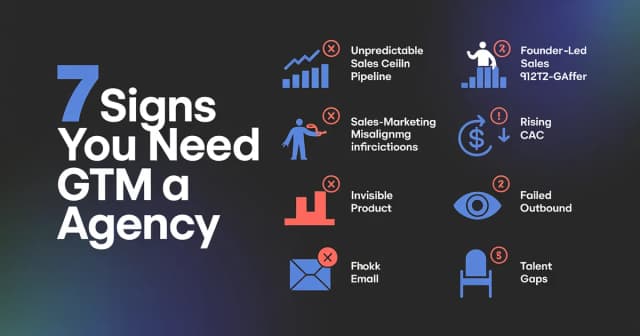
You have product-market fit but not a repeatable sales motion. You've closed deals, you know people want what you sell, but pipeline generation is inconsistent and depends on founder selling or one star rep.
You're entering a new market or segment. You've got a proven product and you need to build the GTM infrastructure for a new ICP, geography, or vertical.
Your GTM functions are siloed. Marketing does its thing, sales does its thing, and nobody can explain how a lead becomes a customer. A GTM strategy exists on paper but not in practice.
You need to scale fast. You just closed a funding round and the board wants pipeline yesterday. Building internally takes six months. A GTM agency compresses that to weeks.
You've outgrown your current setup. The scrappy approach that got you to $2M ARR won't get you to $10M. You need systems, not hustle.
A GTM agency does NOT make sense when:
You don't have product-market fit yet. No amount of GTM infrastructure helps if nobody wants what you're selling. Validate first.
You need a one-off project. If you just need a website redesign or a single email campaign, hire a specialist. A GTM agency engagement is a commitment to building systems.
You're not ready to act on what you learn. GTM agencies surface uncomfortable truths — your ICP is wrong, your pricing is off, your sales process has gaps. If leadership isn't prepared to adjust, the engagement will stall.
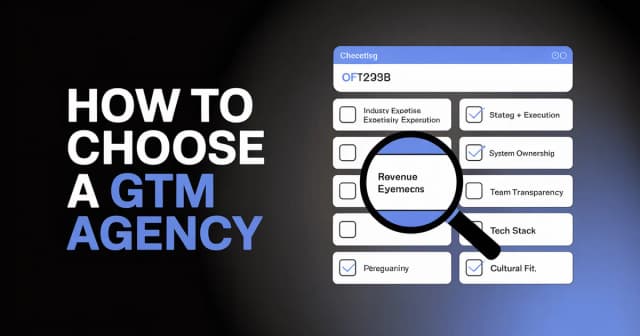
How to Evaluate a GTM Agency
If you're evaluating go to market agencies, here's what I'd look at. And yes, I'm giving you criteria that I believe UpliftGTM meets — but I'd rather you evaluate us rigorously than sign a contract based on a good sales pitch.
1. Do they cover the full GTM spectrum, or just one piece? A true GTM agency operates across outbound, content, enablement, recruitment, and AI. If they only do one of those things, they're a specialist vendor calling themselves a GTM agency.
2. What do you keep if the engagement ends? Ask this directly. If the answer is vague, that's your answer. System ownership should be non-negotiable.
3. Can they show you the specifics of what they've built? Not just case study metrics — actual system architecture. What tools did they configure? What processes did they implement? What does the handover look like? Review our case studies and you'll see we go into this level of detail.
4. Do they understand your market? A GTM agency that's built pipeline for cybersecurity companies will approach things differently than one that's only worked with consumer brands. Domain expertise matters because buyer behaviour varies enormously across tech verticals.
5. How do they measure success? If the answer is impressions, clicks, or MQLs, walk away. A GTM agency measures qualified meetings, pipeline generated, and revenue influenced. Everything else is a leading indicator at best.
6. What's their stance on AI? In 2026, a GTM agency that isn't integrating AI into outbound, content, and analytics is already behind. Ask what they're building, not just what tools they use.
Frequently Asked Questions
What's the difference between a GTM agency and a marketing agency?
A marketing agency handles brand, creative, and campaigns — typically the top-of-funnel awareness layer. A GTM agency builds the end-to-end system from first touch to qualified meeting, including outbound, sales enablement, recruitment, and technology. Read our full breakdown of GTM strategy vs marketing strategy.
How much does a GTM agency cost?
It varies widely based on scope. A targeted outbound engagement might start at $5,000-$10,000/month. A full-stack GTM build across outbound, SEO, enablement, and AI typically runs $15,000-$30,000/month. The better question is ROI — use our SDR ROI calculator to model what pipeline generation actually costs versus hiring internally.
How long before a GTM agency delivers results?
Outbound systems typically generate qualified meetings within 4-6 weeks. SEO is a longer game — expect meaningful organic pipeline in 3-6 months. Sales enablement and AI integrations deliver impact almost immediately once deployed. We set 90-day milestones with every client so there's no ambiguity about what "results" means.
Can a GTM agency work alongside our existing sales team?
Absolutely — in fact, that's the standard model. A GTM agency isn't replacing your team. We're building the systems your team operates within, or supplementing their capacity through SDR as a Service. The best outcomes happen when internal teams and the agency operate as one unit.
What industries do GTM agencies serve?
Most GTM agencies focus on B2B technology. At UpliftGTM, we work with SaaS, cybersecurity, AI and ML, fintech, healthtech, and managed IT service providers. Industry focus matters because the GTM playbook for selling cybersecurity to CISOs is fundamentally different from selling HR software to CHROs.
Should I hire internally or work with a GTM agency?
Both, eventually. A GTM agency builds the systems and proves them out. Then you hire the internal team to run them. Trying to hire first means your new hires spend their first six months building infrastructure instead of generating pipeline. We cover the build-versus-buy decision in detail in our B2B go-to-market strategy framework.
The Bottom Line
A GTM agency does one thing: it builds the go-to-market systems that produce qualified pipeline and revenue for B2B technology companies. Everything we do — outbound, SEO, sales enablement, recruitment, AI, lead generation — serves that outcome.
The best GTM agencies don't create dependency. They create infrastructure you own, systems your team can operate, and a compounding advantage that grows whether the agency is still involved or not.
If you're evaluating whether a GTM agency is the right move for your company, start a conversation with us. We'll tell you honestly whether we're the right fit — and if we're not, we'll point you toward who is.
Founder & CEO of UpliftGTM. Building go-to-market systems for B2B technology companies — outbound, SEO, content, sales enablement, and recruitment.