GTM Agency vs Marketing Agency: What's the Difference?

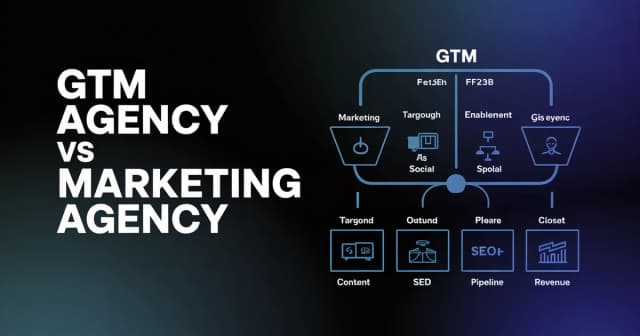
GTM Agency vs Marketing Agency: What's the Difference?
Updated March 2026 — Why the distinction matters for B2B technology companies
I get this question every week from founders. Usually it comes up mid-conversation, after they've described what's not working. "We hired a marketing agency last year and they did good work, but pipeline didn't move." Then they pause. "Someone told us we need a GTM agency instead. Is that just a rebrand, or is it actually different?"
It's different. Meaningfully different. And the confusion between the two costs B2B tech companies real money every quarter.
I'm Jamie Partridge. I run UpliftGTM, a Go To Market agency, GEO agency — featured in our list of GEO agencies and our best AEO agencies shortlist — and AEO services provider that builds revenue systems for B2B technology companies. Before that I spent years watching companies hire marketing agencies when they needed GTM infrastructure, and vice versa. Both are useful. Neither is a substitute for the other. But if you pick wrong, you'll burn through budget and time while your competitors figure it out.
Here's what frustrates me: the labels have been muddied. Some marketing agencies now call themselves GTM agencies because the term sounds more strategic. Some GTM agencies are really just marketing shops with a fancier positioning. So I'm going to lay out exactly what separates the two — not the theoretical version, but based on what I've seen work and fail across dozens of B2B tech engagements.
The Core Difference, Stated Plainly
A marketing agency optimises channels. A GTM agency builds the system that turns those channels into revenue.
That's the one-sentence version. Let me unpack it.
A marketing agency takes the channels you already know about — paid search, social, email campaigns, content, events — and makes them perform better. They'll improve your ad creative, tighten your targeting, build landing pages, run A/B tests. Good marketing agencies do this well, and the work has real value.
But here's the thing. A marketing agency typically operates within a defined lane. They own the top and middle of the funnel. They generate "leads" or "MQLs." What happens after the lead hits the CRM? That's someone else's problem. The handoff to sales, the outbound motion running in parallel, the SDR team's talk tracks, the competitive positioning your AEs need on calls — none of that is on the marketing agency's radar. Salesforce's State of Sales research consistently shows that the marketing-to-sales handoff is where most B2B revenue is lost, and a marketing-only engagement leaves that gap untouched.
A GTM agency sits across the entire revenue motion. From first touch to closed deal. Outbound infrastructure, inbound content, sales enablement, recruitment, AI systems, pipeline analytics. The marketing agency asks "how do we get more leads?" The GTM agency asks "how do we build a repeatable system that produces revenue?"
Different question. Different architecture. Different outcomes.
Side-by-Side Comparison
I'll be direct: tables oversimplify. But this one is useful for framing the conversation with your leadership team.
| Dimension | Marketing Agency | GTM Agency |
|---|---|---|
| Scope | Channel execution — paid, organic, social, email, events | Full go-to-market system — outbound, inbound, sales enablement, recruitment, AI |
| Core Deliverables | Campaigns, content, creative assets, ad management, reports | Outbound infrastructure, SEO systems, enablement materials, SDR programmes, hiring frameworks |
| Primary Metrics | Impressions, traffic, MQLs, engagement rates, cost per lead | Qualified meetings booked, pipeline generated, revenue influenced, sales cycle length |
| Engagement Model | Monthly retainer for ongoing channel management | System build with knowledge transfer, or managed execution via SDR as a Service |
| What You Keep When It Ends | Campaign data, creative assets, maybe some content | Fully configured outbound engine, content systems, enablement library, trained processes |
| Team Structure | Designers, copywriters, media buyers, social managers | Strategists, outbound operators, SDRs, SEO engineers, sales enablement specialists, recruiters |
The metrics row is the one that matters most. If your agency reports on MQLs and you don't know how many of those MQLs became pipeline, you have a measurement gap. And that gap is usually where revenue goes to die. Forrester's research on B2B revenue waterfall models has been pushing the industry away from MQL-only reporting for years, arguing that pipeline and revenue contribution are the only metrics that truly matter at the leadership level.
When You Need a Marketing Agency
Marketing agencies earn their keep in specific situations. I'm not here to bash them — some of the best companies I know work with marketing agencies and get strong returns. Here's when it makes sense:
You have a working sales engine and need more fuel. Your sales team converts well. Your pipeline-to-close rate is solid. You just need more qualified traffic and awareness at the top. A marketing agency can turn up the volume on channels that already work.
You need brand and creative work. Rebrand, new visual identity, event collateral, video production. These are creative disciplines. A GTM agency isn't going to design your booth for SaaStr Annual.
You're running a specific campaign with a clear brief. Product launch, seasonal promotion, ABM display campaign. Defined scope, defined timeline, defined deliverables. Marketing agencies thrive in this model.
Your GTM systems already exist and you need channel specialists. If you've already built your outbound motion, your sales process is tight, and your enablement materials are solid — then what you need is someone to pour more fuel into specific channels. That's a marketing agency's sweet spot.
When You Need a GTM Agency
You're generating leads but pipeline isn't growing. This is the number one symptom. The marketing agency delivers MQLs on target, but your sales team isn't closing. The problem isn't the leads. The problem is the system between lead and revenue. According to HubSpot's State of Marketing reporting, most B2B teams cite alignment between marketing and sales — not lead volume — as the single biggest constraint on growth.
You don't have an outbound motion. Marketing agencies don't build outbound systems. They don't set up domain infrastructure, configure sequencing tools, build prospect lists based on intent signals, or train SDRs on multi-threaded outreach. That's the territory of a GTM agency or a specialist SDR agency.
Your sales team can't articulate your value. You've invested in content and brand but your reps are still winging it on calls. Sales enablement that actually gets used requires someone who understands both the messaging and the sales motion. That requires a GTM agency.
You need to hire GTM roles and keep getting it wrong. You've burned through two BDR managers. Your VP of Sales lasted eight months. A GTM agency that handles recruitment — or partners with one of the best GTM recruitment agencies — knows what "good" looks like for your specific stage, deal size, and market.
You're a B2B tech company scaling past founder-led sales. You closed your first 20 customers through hustle, network, and late nights. Now you need a machine. Marketing agencies don't build machines. GTM agencies do.
Work with UpliftGTM
Want a team to build this for you?
UpliftGTM designs and runs outbound, SDR and SEO systems for B2B technology companies. Book a call and we'll map it to your pipeline.
The Overlap Zone
I'll be honest — there's real overlap between a GTM agency and a marketing agency. Pretending otherwise would be dishonest. Here's where they intersect, and where they absolutely don't.
Where They Overlap
Content production. Both create content. A marketing agency produces blog posts, social media content, email newsletters. A GTM agency — or one of the best SaaS SEO agencies — produces SEO-driven content tied to buying intent keywords, case studies built for sales enablement, and competitive comparison pages. Different intent, similar output format.
Demand generation. Both generate demand. A marketing agency runs paid campaigns and nurture sequences. A GTM agency — or a specialist demand generation agency — builds demand gen as one component of a multi-channel revenue system. The tactics can look similar on the surface.
Analytics and reporting. Both measure things. The difference is what they measure and who they report to. Marketing agencies report to the CMO on campaign performance. GTM agencies report to the CRO or CEO on pipeline and revenue.
Where They Don't Overlap
Outbound infrastructure. Marketing agencies don't touch this. Domain warming, deliverability, cold email systems, SDR management — this is entirely GTM agency work. If your marketing agency claims to do outbound, ask them about domain rotation strategy. The answer will tell you everything.
GTM recruitment. Hiring SDRs, AEs, sales leaders (or commissioning one of the best fractional VP Sales services in the interim), RevOps talent. Marketing agencies have no business here, and good ones know that.
Sales enablement that connects to the sales process. Not "content for sales" — actual enablement. Battle cards built from real competitive intelligence. Discovery frameworks tested on live calls. Onboarding programmes that get new reps to quota faster. This requires someone embedded in the revenue process.
SDR as a Service. Running trained, managed outbound reps as an extension of your team. Marketing agencies don't offer this because it's not marketing. It's sales development, and it requires a completely different operational model.
What I've Seen Go Wrong
Most marketing agencies won't tell you this, but I will.
We had a client — a SaaS company in the project management space — who spent $120K over twelve months with a well-respected marketing agency. The agency delivered exactly what was promised: redesigned website, monthly blog posts, paid search campaigns, a solid content calendar. Traffic was up 140%. The marketing agency hit every KPI in their contract.
Pipeline was flat. Revenue was actually down.
Why? Because the website attracted the wrong traffic. The blog content targeted high-volume keywords with zero buying intent. The paid campaigns drove demo requests from companies that were too small to close. And nobody — not the agency, not the client's marketing team — was looking at what happened after someone filled out a form. The sales team was drowning in unqualified conversations.
When we stepped in, we didn't throw out the marketing agency's work. Some of it was genuinely good. But we rebuilt the targeting around ICP criteria that matched their actual closed-won profile. We built an outbound system to go after their ideal accounts directly instead of waiting for them to find the website. We created sales enablement materials so reps could handle the three objections that killed 60% of their deals. We restructured their SDR team's workflow so they stopped wasting time on leads that would never close.
Pipeline tripled in five months. Not because we're smarter than the marketing agency. Because we were solving a different problem.
Another example. A cybersecurity firm — similar to the work we did with Versa Networks — had a marketing agency running ABM display campaigns. Beautiful creative. Precise targeting. Great engagement metrics. But the company had no outbound motion, no follow-up sequences for accounts that engaged with the ads, and no SDRs trained to have technical conversations with CISOs and security architects.
The ABM campaigns were generating awareness with zero conversion infrastructure behind them. Like running a Super Bowl ad with no phone number on the screen.
We built the outbound layer that turned that awareness into booked meetings. The marketing agency kept running the ABM campaigns. The GTM agency built the system that caught what the campaigns generated. That's how the two should work together — when they work together.
How to Tell Which You Need: A Decision Framework
Forget the abstract strategy conversations. Here's a practical framework based on company stage, team size, and what's actually broken.
If you have less than $2M ARR and fewer than 5 salespeople: You probably need a GTM agency. You don't have repeatable systems yet. You need someone to build the infrastructure — outbound, enablement, ICP definition — that turns founder-led sales into a scalable motion. A marketing agency at this stage is premature optimisation. You're tuning channels before the engine exists.
If you have $2M-$10M ARR and 5-20 salespeople: This is the danger zone. You might need both. The question is: can your sales team articulate your value, handle objections, and follow a consistent process? If yes, a marketing agency can help you scale what's already working. If no, you need a GTM agency to fix the foundation before you pour more traffic into a broken funnel.
If you have $10M+ ARR and a functioning sales org: You likely need a marketing agency for channel execution and a GTM agency for strategic system improvements — new market entry, outbound expansion, AI integration, SDR as a Service to supplement your team during a push into new verticals.
The litmus test: Ask your VP of Sales if they'd rather have 500 more MQLs next month or a fully configured outbound system targeting their ideal accounts. If they want the MQLs, you probably need a marketing agency to drive volume. If they want the system, you need a B2B GTM agency.
Why This Distinction Matters for B2B Tech Specifically
I've focused on B2B technology companies throughout this piece, and that's intentional. The GTM agency vs marketing agency distinction hits harder in B2B tech than anywhere else. Here's why.
The sales cycle is long and multi-threaded. You're not selling shoes online. A $50K-$500K deal involves 4-8 stakeholders, takes 3-9 months, and requires touchpoints across outbound, content, events, and direct sales engagement. A marketing agency handles maybe two of those touchpoints. A GTM agency architects the full sequence.
The buyer is technical and sceptical. Cybersecurity buyers, engineering leaders, IT directors — these people see through generic marketing immediately. They want specifics. They want proof. They want to talk to someone who understands their stack. Marketing agencies produce content for these buyers. GTM agencies build the systems that earn credibility with them across every interaction. LinkedIn's B2B sales research shows that technical buyers now spend the majority of their decision cycle independently researching vendors before they ever talk to sales — which is exactly why a coordinated GTM system, not a single channel, has become the deciding factor.
The competitive landscape moves fast. In B2B tech, your competitor launched a new feature yesterday and is already outbounding your prospects about it. You need systems that adapt quickly — not a marketing calendar locked in three months ago. A GTM agency operates at the speed of your market. Like the work we did with Clarizen, where we iterated outbound sequences weekly based on competitive intelligence.
Channel effectiveness decays faster. What worked in paid search six months ago is more expensive and less effective today. The email approach that booked meetings in Q1 stopped working in Q3. B2B tech GTM requires constant iteration across multiple channels simultaneously. A marketing agency iterates within their channel. A GTM agency iterates across the system. The HubSpot sales blog tracks these shifts every quarter, and the pattern is consistent — channels that produced reliable pipeline a year ago need a different play today, and only a cross-channel operator catches that decay early enough to redirect spend.
You need to own the infrastructure. B2B tech companies that build lasting competitive advantage own their GTM systems. They don't rent them. When you work with a marketing agency, you're buying campaign execution. When you work with a GTM agency, you're building assets — outbound playbooks, content engines, enablement libraries — that compound over time and stay with you regardless of which partners you work with next.
The Bottom Line
A marketing agency and a GTM agency are different tools for different problems. One optimises channels. The other builds revenue systems. One reports on leads generated. The other reports on pipeline created and revenue influenced.
Neither is inherently better. But hiring the wrong one for your situation is expensive — in dollars, in time, and in the opportunity cost of not building what you actually needed.
If you're a B2B technology company that already has repeatable systems and needs channel-level execution, find a strong marketing agency. If you need the systems themselves — outbound infrastructure, sales enablement, SDR operations, the connective tissue between marketing and revenue — that's what a B2B GTM agency builds.
Not sure which one you need? Talk to us. I'll tell you honestly — even if the answer is that you need a marketing agency, not us. Getting the right partner matters more than getting a signed contract.
Founder & CEO of UpliftGTM. Building go-to-market systems for B2B technology companies — outbound, SEO, content, sales enablement, and recruitment.

![What Does a GTM Agency Do? The Complete Guide [2026]](/_next/image?url=%2Fimages%2Fblog%2Fwhat-does-a-gtm-agency-do-hero.webp&w=640&q=75)