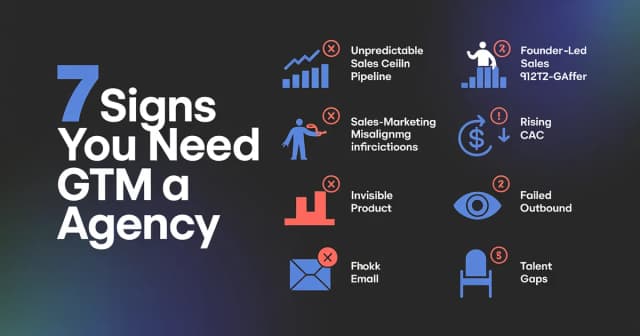
7 Signs Your B2B Company Needs a GTM Agency
Updated March 2026 — The warning signs that it's time to get external GTM help
Nobody wakes up one morning and decides they need a GTM agency. It's more of a slow realisation. The board meeting where you can't explain why pipeline dropped 40% last quarter. The Sunday night dread when you check the CRM and there's nothing new in it. The third VP of Sales candidate who turned you down — making you wonder whether shortlisting one of the best fractional VP Sales services would get you moving faster.
I've been running UpliftGTM — the GTM practice, our GEO agency arm, and our AEO offering, which we benchmark against the best AEO agencies in the market — for long enough now that I can usually tell within the first fifteen minutes of a call whether a company actually needs us. Not because I'm some kind of genius — because the same seven patterns keep showing up. Every time. Across SaaS, cybersecurity, fintech, healthtech, AI startups — doesn't matter. The symptoms are remarkably consistent.
So here they are. Seven signs your B2B company needs a GTM agency. If three or more of these hit close to home, we should probably talk.
1. Your Pipeline Is a Rollercoaster
This is the one I hear most often, and it's usually the reason for the first phone call. January was incredible — record meetings booked, pipeline stacked, everyone's feeling good. February was solid. Then March through May? Nothing. Tumbleweed. The CRM looks like a ghost town and nobody can explain what changed.
Sound familiar?
Here's what's actually happening. You don't have a pipeline problem. You have a pipeline system problem. The months that felt amazing were probably driven by a conference you attended, a LinkedIn post that went semi-viral, or a burst of outbound activity when someone on the team had bandwidth. When those one-off efforts faded, so did the pipeline. There was never a system generating consistent opportunities in the background — just a series of activities that sometimes worked and sometimes didn't. Salesforce's State of Sales research keeps reinforcing the same point: high performers treat pipeline as a system, not a streak.
I sat in a board meeting last year with a Series B SaaS company that had closed $800K in Q1 and $180K in Q2. Same product. Same team. Same market. The difference was that their Q1 pipeline had been generated by three specific events the founder attended in late Q3 of the previous year. When he stopped attending events to focus on product, the pipeline dried up six months later. Nobody connected the dots until it was too late.
A GTM agency fixes this by building multiple pipeline channels that run concurrently and compound over time. Outbound generates meetings this month. SEO and content — typically run by one of the top SaaS SEO agencies — builds a pipeline of inbound leads that grows quarter over quarter. SDR as a Service fills the gaps while you build internal capacity. The point isn't any single channel — it's the system that ensures pipeline never depends on one person's calendar or one lucky LinkedIn post.
We built this kind of multi-channel system for Clarizen, and the shift from rollercoaster to predictable was dramatic. Not because we did anything revolutionary. Because we built a system and ran it consistently. That's the part most companies skip.
2. The Founder Is Still Closing Every Deal
This is the one that kills me. Because the founder is usually brilliant at selling. They know the product inside out, they radiate conviction, they can handle any objection because they've lived every feature decision. And therein lies the problem.
If you're the founder and you're still the primary closer at $2M ARR, you don't have a sales motion. You have a founder motion. And founder motions don't scale. HubSpot's sales research blog has documented the same pattern across thousands of growing companies — founder selling stops compounding the moment the founder runs out of hours.
I worked with a technical founder last year — incredible product in the networking space, genuinely differentiated technology. He could close enterprise deals that his two AEs couldn't even get meetings for. So what did he do? He kept closing deals himself. The AEs sat idle, eventually churned, and the founder was working 80-hour weeks doing product, fundraising, AND sales. When he got sick for two weeks, pipeline stopped entirely. Not slowed down. Stopped.
The hard truth is that founder-led sales gets you to about $2-3M ARR. Past that, it becomes the bottleneck. You can't be in every demo, every negotiation, every QBR. And the longer you try, the harder it becomes to eventually hand off — because no one else on the team has ever closed a deal without you in the room.
A GTM agency breaks this pattern in a few ways. First, we build sales enablement materials that capture what the founder instinctively does — the objection handling, the discovery questions, the way they position against competitors — and turn it into a repeatable playbook that others can execute. Second, we set up the outbound infrastructure that generates meetings without the founder's personal network. Third, through GTM recruitment, we help hire the right people who can actually run this playbook — not just another AE with a good interview but someone who's operated at your stage and deal size before.
The goal isn't to remove the founder from sales entirely. It's to make the founder optional. When you can go on a two-week holiday and pipeline doesn't skip a beat, you've cracked it.
3. Sales and Marketing Are Pointing Fingers
"Marketing gives us garbage leads." "Sales doesn't follow up on the leads we give them." I've heard some version of this in probably 60% of the companies I've worked with. It's the classic misalignment, and it's almost never actually about lead quality or follow-up speed. It's about the fact that sales and marketing are operating as two separate teams with two separate dashboards tracking two separate sets of metrics, and nobody's built the bridge between them.
Here's how it typically plays out. Marketing runs a webinar. Gets 200 registrants. Marks them as MQLs and throws them over the wall to sales. Sales calls ten, gets voicemail on eight, has two conversations that go nowhere, and writes off the whole batch. Marketing sees that sales only touched 5% of their leads and screams about it in the next all-hands. Sales says the leads were rubbish. Both sides pull up their own data to prove they're right. Nothing changes.
The real problem? Nobody agreed on what a qualified lead looks like. Nobody built the handoff process. Nobody instrumented the journey from first touch to closed-won so both teams could see the same picture. There's no shared pipeline number. There's no common definition of an ICP. Marketing is optimising for volume and sales is judging on quality, and they're both right and both wrong simultaneously.
This is fundamentally a go-to-market strategy problem, not a people problem. Research from Forrester has long shown that aligned revenue teams outperform their siloed peers across pipeline, win rate, and retention. A GTM agency — or a demand generation agency with cross-functional reach — sits above both functions and builds the connective tissue. We define the ICP together — firmographics, technographics, buying signals — so both teams are targeting the same accounts. We build lead scoring and routing so the right leads get to sales at the right time with the right context. We create shared dashboards that show the full funnel, not just each team's piece of it. And we implement SLAs for follow-up that are reasonable and measurable.
I wrote more about bridging this gap in our piece on implementing RevOps in B2B technology companies. But the short version is this: if your sales and marketing leaders can't sit in the same room and agree on a pipeline number, you need external help to broker that conversation. Internal politics make it nearly impossible to solve from within.
4. Your CAC Keeps Climbing
Pull up your customer acquisition cost for the last four quarters. If the line is going up and to the right, you've got a problem that won't fix itself.
I see this constantly in SaaS companies between $3M and $15M ARR. The channels that got them their first few hundred customers — founder's network, product-led growth, a bit of paid — start to plateau. So they spend more on ads. Bid higher on keywords. Hire more fractional SDRs. Run more events. Each incremental customer costs more than the last, and nobody's introducing new playbooks.
One fintech company I worked with had seen their CAC go from $8,000 to $22,000 over eighteen months. Same product, same price point, same market. They'd been running the same Google Ads campaigns for two years, and their cost per lead had tripled as the fintech space got more crowded. According to HubSpot's marketing research, paid acquisition costs in crowded B2B categories have continued to climb year over year, which is why teams stuck on a single channel feel the squeeze first. Their outbound was all manual — reps copying and pasting the same templates that stopped working a year ago. Their content was a blog that hadn't been updated in six months, and they had no SaaS SEO agency engaged to fix it.
Climbing CAC is a signal that your current GTM playbooks have been exhausted. You need new channels, new approaches, and better systems to extract more value from the ones you already have.
A GTM agency attacks this from multiple angles. We build organic pipeline through SEO — the lowest-CAC channel in B2B when done right, because it compounds over time instead of resetting to zero every month like paid. We rebuild outbound systems with fresh messaging, proper infrastructure, and AI-powered personalisation that dramatically improves conversion rates. We look at your entire funnel and find the leaks — the places where you're spending to get attention but losing prospects before they convert.
Our work with Versa Networks was largely a CAC story. By building systematic pipeline generation across multiple channels, we reduced their dependency on the expensive, low-yield activities that were driving acquisition costs up.
Work with UpliftGTM
Want a team to build this for you?
UpliftGTM designs and runs outbound, SDR and SEO systems for B2B technology companies. Book a call and we'll map it to your pipeline.
5. You Have a Great Product Nobody Knows About
I have a real soft spot for this one. You've got a team of brilliant engineers who've built something genuinely excellent. The product works. The customers you do have love it. NPS is high, churn is low, and when people actually see the product, they buy it. The problem is that almost nobody sees it.
This is incredibly common in AI and machine learning companies and deep-tech startups. The founding team can explain the technology in extraordinary detail to another engineer. But they cannot, for the life of them, explain why a VP of Operations at a mid-market logistics company should care. The website reads like a technical white paper. The sales deck is forty slides of architecture diagrams. The one-liner on the homepage uses three acronyms that only people in the industry understand.
I worked with a healthtech company last year that had genuinely material technology. Clinical outcomes were measurably better with their platform. They had published research, happy pilot customers, the works. Revenue? Under $1M. Because nobody outside their immediate network knew they existed. Their marketing was a single founder posting on LinkedIn once a fortnight and occasionally attending a conference where they'd staff a booth but never follow up with the leads they collected.
The product-market fit was there. The go-to-market fit was completely absent.
A GTM agency bridges this gap between having a great product and having a great business. We start with positioning and messaging — translating what your product does into language your buyers actually use. Not dumbing it down. Making it accessible. Then we build the distribution. SEO content that targets the searches your buyers make. Outbound campaigns that get you in front of the right decision-makers. B2B lead generation that fills your calendar with qualified meetings where you can actually show the product to people who need it.
If you've nailed the product but the world doesn't know it exists, that's not a marketing failure — it's a GTM infrastructure gap. And it's fixable, usually faster than you'd think.
6. Your Outbound Is Broken
Low open rates. No replies. Generic sequences. Emails landing in spam. LinkedIn messages that read like they were written by someone who's never actually used the platform. Your SDRs — or the SDR agency you hired — burning through lists with nothing to show for it.
I've audited hundreds of outbound programmes at this point, and the problems are depressingly consistent. The messaging is self-centred — it talks about the product instead of the prospect's problem. The targeting is too broad — spraying thousands of emails at anyone with a title that vaguely matches. ZoomInfo's cold-calling and outbound benchmarks underline how brutal the conversion math gets the moment relevance drops. The infrastructure is broken — primary domains being used for cold email, no warming, no monitoring, shared sending IPs that are already blacklisted. The sequences are too long or too short. The follow-up timing is wrong. The call-to-action asks for too much too soon.
One software company I worked with had their SDRs sending 400 emails a day from the company's primary domain. No secondary domains, no warming period, no deliverability monitoring. They'd been doing this for three months. By the time they called us, their primary domain sender reputation was destroyed. Emails from their CEO to existing customers were landing in spam. It took weeks just to rehabilitate the domain before we could even think about building a proper outbound programme.
Outbound in 2026 is a technical discipline. It requires infrastructure (domain warming, deliverability monitoring, CRM configuration), strategy (ICP refinement, persona-specific messaging, trigger-based sequencing), and execution (consistent daily activity, weekly iteration on messaging, disciplined follow-up). Most companies get one of those three right. Very few get all three without external help.
A GTM agency builds the complete outbound system. We set up the technical infrastructure properly from day one. We write messaging that gets replies because it's relevant, specific, and concise. We leverage AI tools to personalise at scale without losing the human touch. And we either train your team to run it or deploy our own SDRs as a Service to execute while your team ramps.
If you want to go deeper on what good outbound looks like, our SDR as a Service guide and our piece on cybersecurity SDR strategies are good starting points. But the bottom line is this: if your outbound isn't booking qualified meetings consistently, the system is broken — not the channel.
7. You Can't Hire GTM Talent
This might be the most painful one on the list. You know you need a VP of Sales. Or a Head of Marketing. Or even just competent SDRs. And you simply cannot find them.
The VP of Sales candidates who've actually built pipeline at your stage want $250K+ base plus equity, and they've got three other offers from companies with bigger brands and larger budgets. The strong SDRs you interview take roles at big tech companies that offer higher OTE, better training programmes, and a career path you can't match at your size. The marketing hire you made six months ago came from a completely different industry and is still trying to understand your ICP. The LinkedIn Sales Solutions blog tracks how hiring cycles for senior B2B sales talent have stretched out as competition has intensified — by the time a candidate accepts, you've already burned a quarter of runway waiting.
I hear this from MSPs and mid-market B2B companies constantly. They're competing for talent against well-funded startups and established tech giants, and they're losing. So they either over-pay for mediocre talent, or they go without and try to muddle through with what they have.
Here's the thing that most founders don't realise: you don't necessarily need to hire your way out of this. At least not yet.
A GTM agency effectively gives you access to an entire GTM team — strategists, outbound specialists, content marketers, SDRs, data analysts, and even AI-search specialists from the best GEO agencies — without the recruitment timeline, the ramp period, or the risk. Through our GTM recruitment service and our roundup of the best GTM recruitment agencies, we also help you hire the right people when you're ready, because we've been operating the systems and we know exactly what profile will succeed in running them.
The sequencing matters. Build the systems first with agency support. Prove out the playbooks. Then hire the people to run them. If you hire first and hope they'll build the systems, you're asking a brand-new employee to simultaneously figure out what to build, build it, and hit a pipeline number. That almost never works. We've covered the build-versus-buy decision in our go-to-market strategy framework, and the pattern is clear: companies that systemise first and hire second get to revenue faster.
Our work with Totalmobile and Comtrac followed exactly this model. We built the GTM infrastructure, demonstrated what worked, and then helped them bring the right people in-house to take ownership of a proven system. That's a fundamentally different proposition than handing a new hire a blank sheet of paper and wishing them luck.
What to Do Next
If you read through those seven signs and recognised your company in three or more, that's not a coincidence. These problems are interconnected — unpredictable pipeline leads to rising CAC, which leads to hiring pressure, which leads to misalignment between teams, which makes the pipeline even more unpredictable. It's a cycle, and it won't break on its own.
Here's a quick self-assessment. Give yourself one point for each:
- Your pipeline variance between best and worst quarter last year was greater than 50%
- The founder or CEO is directly involved in more than 30% of closed deals
- Sales and marketing don't share a single pipeline dashboard
- Your CAC has increased quarter over quarter for three or more consecutive quarters
- Your NPS is above 40 but your revenue growth is below 20% year-over-year
- Your outbound reply rate is below 3%
- You've had a GTM leadership role open for more than 90 days
Score 1-2: You've got specific gaps you can probably address with targeted hires or specialist vendors. Our blog has frameworks for most of these.
Score 3-4: You've got systemic GTM issues. Individual fixes won't solve it — you need a coordinated approach. Read our piece on what a GTM agency actually does and see if the model makes sense for your situation.
Score 5-7: You need help, and you probably needed it six months ago. The good news is that these problems are fixable, and they're fixable faster than most founders expect.
Whatever your score, here's what I'd suggest: book a conversation with us. Not a sales pitch. A diagnostic call. We'll walk through your current GTM setup, identify where the gaps are, and give you an honest take on whether an agency is the right move or whether there's a simpler fix. If we're not the right fit, I'll tell you — and I'll point you toward whoever is.
The companies that grow past the ceiling aren't the ones with the best products. They're the ones that build the best go-to-market systems. And if you can't build them alone, there's no shame in bringing in a team that's done it before.
Get in touch. Let's figure out what's broken and what it'll take to fix it.

Founder & CEO of UpliftGTM. Building go-to-market systems for B2B technology companies — outbound, SEO, content, sales enablement, and recruitment.

![What Does a GTM Agency Do? The Complete Guide [2026]](/_next/image?url=%2Fimages%2Fblog%2Fwhat-does-a-gtm-agency-do-hero.webp&w=640&q=75)